Writers often rely on subtlety to convey deeper meaning, and one of the most refined tools for this purpose is allusion. However, mastering language isn’t just about knowing how to imply—it’s equally about knowing how to state things directly when clarity matters.
Understanding opposites of key linguistic concepts like allusion can dramatically sharpen your writing.
Why does this matter? Because communication operates on a spectrum between subtle suggestion and explicit declaration. In academic, professional, and persuasive writing, the ability to shift between these modes gives you precision and control.
While allusion enriches creative writing, its opposites are essential in reports, research papers, legal documents, and business communication—where ambiguity can lead to misunderstanding.
Learning antonyms for allusion helps you:
- Improve clarity and transparency
- Avoid misinterpretation
- Strengthen persuasive impact
- Adapt tone to different audiences
This guide provides a comprehensive, SEO-optimized exploration of 21 antonyms for allusion, complete with meanings, tone labels, examples, and usage insights.
What Does “Allusion” Mean?
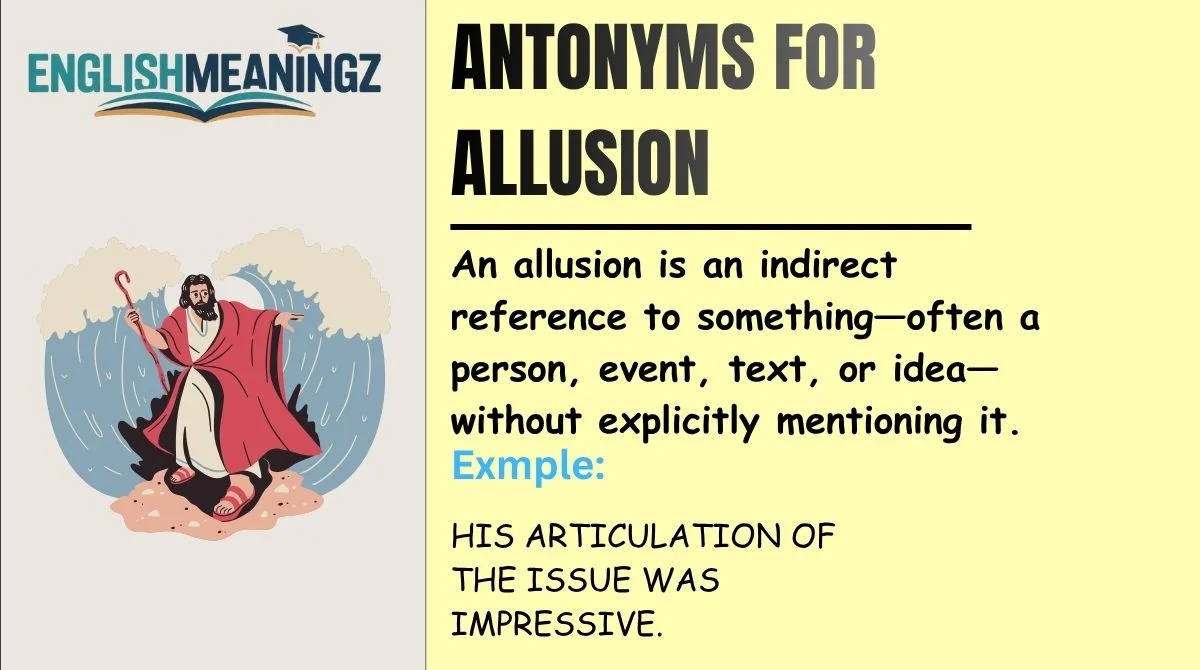
An allusion is an indirect reference to something—often a person, event, text, or idea—without explicitly mentioning it.
Definition
A brief and subtle reference that relies on the reader’s prior knowledge to understand its meaning.
Tone Explanation
Allusions are typically:
- Subtle
- Suggestive
- Intellectual
- Indirect
They require interpretation rather than offering direct explanation.
Emotional or Action Intensity
Allusion has low direct intensity but high interpretive depth. It invites the reader to “connect the dots” rather than presenting information plainly.
21 Best Antonyms for “Allusion”
Explicit Statement
Meaning: A clear and direct expression
Tone: Formal / Academic
Example: The report explicitly states the cause of the failure.
Why Opposite: It removes all ambiguity and leaves no room for interpretation.
Direct Reference
Meaning: Openly mentioning something
Tone: Neutral / Academic
Example: She made a direct reference to the policy change.
Why Opposite: Unlike allusion, it names the subject clearly.
Declaration
Meaning: A formal announcement
Tone: Formal
Example: The government issued a declaration of intent.
Why Opposite: It communicates openly rather than hinting.
Statement
Meaning: A clear expression of facts or opinions
Tone: Neutral
Example: His statement clarified the situation completely.
Why Opposite: It prioritizes clarity over subtlety.
Explanation
Meaning: Detailed clarification
Tone: Academic
Example: The teacher gave a full explanation of the concept.
Why Opposite: Allusion avoids explanation; this embraces it.
Disclosure
Meaning: Revealing information openly
Tone: Formal
Example: The company made full disclosure of its finances.
Why Opposite: It exposes what allusion conceals.
Revelation
Meaning: Making something previously hidden known
Tone: Dramatic / Formal
Example: The investigation led to a shocking revelation.
Why Opposite: It brings clarity rather than hinting.
Clarification
Meaning: Making something easier to understand
Tone: Academic
Example: She provided clarification during the meeting.
Why Opposite: Eliminates ambiguity entirely.
Specification
Meaning: Detailed description
Tone: Technical / Academic
Example: The contract includes exact specifications.
Why Opposite: Focuses on precision instead of suggestion.
Articulation
Meaning: Clear expression of ideas
Tone: Formal
Example: His articulation of the issue was impressive.
Why Opposite: Expresses ideas directly.
Elaboration
Meaning: Expanding with details
Tone: Academic
Example: The author elaborated on the theory extensively.
Why Opposite: Adds detail rather than implying.
Exposition
Meaning: Comprehensive explanation
Tone: Academic
Example: The lecture provided a full exposition of the topic.
Why Opposite: Leaves nothing implied.
Transparency
Meaning: Openness and clarity
Tone: Professional
Example: Transparency is crucial in leadership.
Why Opposite: Opposes hidden or indirect meaning.
Plain Speaking
Meaning: Speaking clearly and directly
Tone: Informal
Example: He is known for plain speaking.
Why Opposite: Rejects subtlety.
Straightforwardness
Meaning: Honesty and simplicity
Tone: Neutral
Example: Her straightforwardness is refreshing.
Why Opposite: Avoids indirect hints.
Candor
Meaning: Honest and open expression
Tone: Formal
Example: He spoke with complete candor.
Why Opposite: Emphasizes openness over subtlety.
Directness
Meaning: Clear and unambiguous communication
Tone: Neutral
Example: Directness improves efficiency.
Why Opposite: Removes interpretive layers.
Openness
Meaning: Willingness to share information
Tone: Neutral
Example: Openness builds trust.
Why Opposite: Opposes concealed references.
Literal Expression
Meaning: Exact, non-figurative wording
Tone: Academic
Example: The sentence uses literal expression.
Why Opposite: Avoids implied meaning.
Disclosure Statement
Meaning: Formal sharing of facts
Tone: Formal
Example: The disclosure statement outlined all risks.
Why Opposite: Fully reveals instead of hinting.
Plain Statement
Meaning: Simple and direct communication
Tone: Neutral
Example: The plain statement resolved confusion.
Why Opposite: Eliminates interpretive effort.
Strong vs Mild Opposites
Not all antonyms oppose allusion with the same intensity. Some are absolute, while others are softer alternatives.
Strong Opposites
These completely reject indirectness:
- Explicit statement
- Declaration
- Disclosure
- Revelation
These are ideal for legal, academic, or technical contexts where precision is critical.
Mild Opposites
These lean toward clarity but still allow nuance:
- Clarification
- Elaboration
- Straightforwardness
- Candor
They are commonly used in conversational or semi-formal writing.
Intensity Scale
Allusion → Suggestion → Clarification → Explanation → Explicit Statement
The further you move right, the more direct and unambiguous the communication becomes.
Context-Based Opposites
The best antonym depends on context. Here’s how to choose:
- Academic writing: Explanation, exposition, specification
- Business communication: Transparency, disclosure, directness
- Casual conversation: Plain speaking, straightforwardness
- Legal documents: Declaration, explicit statement, disclosure
For example, replacing an allusion in a research paper with exposition improves clarity, while in a conversation, plain speaking feels more natural.
Common Mistakes When Using Opposites
Using Direct Words in Creative Writing
❌ The story explained every symbol directly.
✔ The story used subtle references instead.
Issue: Overuse of directness kills artistic depth.
Confusing Explanation with Statement
❌ He made an explanation about the rule.
✔ He made a statement about the rule.
Issue: Explanation implies detail; statement may not.
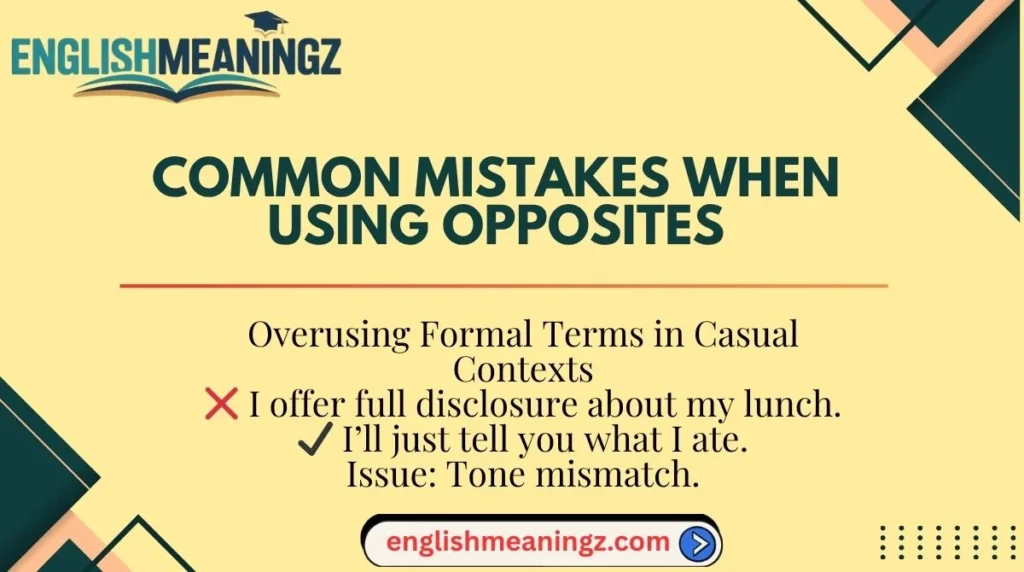
Overusing Formal Terms in Casual Contexts
❌ I offer full disclosure about my lunch.
✔ I’ll just tell you what I ate.
Issue: Tone mismatch.
Replacing Allusion Incorrectly
❌ The poem had a declaration to mythology.
✔ The poem had a reference to mythology.
Issue: Not all antonyms fit every sentence.
Sentence Transformation Examples
Original (Allusion-Based)
- He hinted at past failures.
→ He made a direct statement about past failures. - The speech alluded to economic problems.
→ The speech explicitly addressed economic problems. - She made subtle references to history.
→ She provided a detailed explanation of historical events. - The novel hints at political unrest.
→ The novel clearly describes political unrest. - The article alludes to corruption.
→ The article openly reveals corruption.
FAQs
What is the simplest antonym for allusion?
The simplest antonym is explicit statement, as it directly contrasts indirect reference.
Are all antonyms always formal?
No. Some, like plain speaking, are informal, while others are highly formal.
Can allusion and its antonyms be used together?
Yes, skilled writers often balance both for stylistic effect.
Which antonym is best for academic writing?
Explanation, exposition, and clarification are most suitable.
Is “directness” always better than allusion?
Not always. It depends on the purpose—clarity vs artistic depth.
Can antonyms change tone significantly?
Yes. Switching from allusion to explicit language makes writing more authoritative.
Why should writers learn antonyms of allusion?
It enhances versatility, allowing precise control over clarity and subtlety.
Conclusion
Understanding antonyms for allusion equips you with the power to shift from subtle implication to crystal-clear communication.
Whether you’re writing academic papers, business reports, or persuasive content, knowing when to replace indirect references with explicit language can dramatically improve effectiveness.
While allusion enriches creativity, its opposites—like explicit statement, clarification, and disclosure—ensure your message is understood without confusion.
Mastering both ends of this spectrum allows you to adapt your writing style to any context with confidence and precision.