Understanding opposites is one of the fastest ways to sharpen your writing and communication skills. When you know not just what a word means—but also what it does not mean—you gain precision, control, and depth in expression.
This is especially useful for writers, students, marketers, and professionals who rely on clarity and tone to influence readers.
In academic and professional contexts, using the right antonym can transform vague language into sharp, impactful communication. It helps avoid redundancy, strengthens arguments, and ensures that your message carries the intended emotional or intellectual weight.
In this guide, you’ll explore the word “allure” in depth and discover 23 carefully selected antonyms that will expand your vocabulary and improve your writing.
What Does “Allure” Mean?
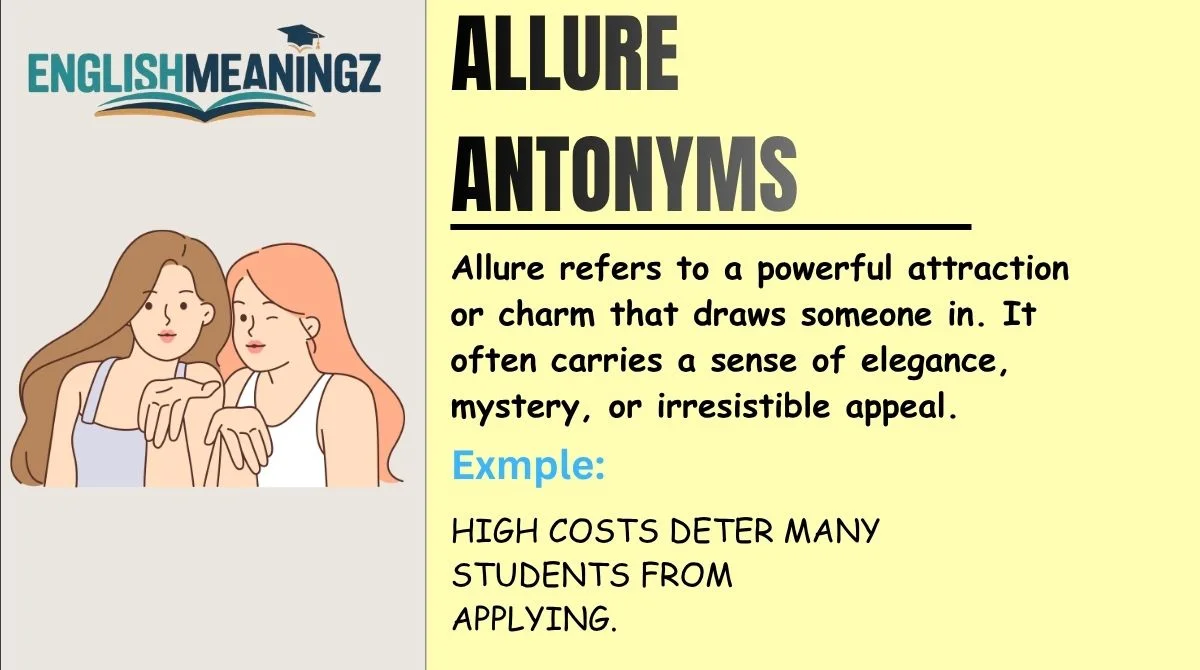
Allure refers to a powerful attraction or charm that draws someone in. It often carries a sense of elegance, mystery, or irresistible appeal.
Tone Explanation:
The word has a positive, seductive, and persuasive tone. It suggests something captivating—whether it’s a person, place, idea, or object.
Emotional Intensity:
Allure operates on a moderate to strong emotional level. It doesn’t just attract—it enchants or fascinates, often subtly.
23 Best Antonyms for “Allure”
1. Repel
Meaning: To drive away or push back
Tone: Formal
Example: His rude behavior repelled potential clients.
Why Opposite: Instead of attracting, it creates distance and rejection.
2. Deter
Meaning: To discourage someone from doing something
Tone: Academic
Example: High costs deter many students from applying.
Why Opposite: Allure invites action; deter prevents it.
3. Disgust
Meaning: To cause strong dislike or revulsion
Tone: Emotional
Example: The foul smell disgusted everyone nearby.
Why Opposite: Allure pleases; disgust repulses deeply.
4. Repulse
Meaning: To cause intense aversion
Tone: Formal
Example: His arrogance repulsed the audience.
Why Opposite: Repulse is a stronger rejection than mere dislike.
5. Bore
Meaning: To fail to interest
Tone: Informal
Example: The lecture bored the entire class.
Why Opposite: Allure excites; bore dulls interest.
6. Alienate
Meaning: To cause someone to feel isolated
Tone: Academic
Example: His harsh words alienated his friends.
Why Opposite: Allure connects; alienate separates.
7. Offend
Meaning: To upset or insult
Tone: Neutral
Example: The comment offended many listeners.
Why Opposite: Offense pushes people away emotionally.
8. Disenchant
Meaning: To remove charm or illusion
Tone: Formal
Example: Reality disenchanted her dreams.
Why Opposite: Allure creates charm; disenchant removes it.
9. Appall
Meaning: To shock or horrify
Tone: Emotional
Example: The news appalled the nation.
Why Opposite: Allure attracts; appall shocks negatively.
10. Discourage
Meaning: To reduce confidence or enthusiasm
Tone: Academic
Example: Constant failure discouraged him.
Why Opposite: Allure motivates; discourage weakens motivation.
11. Dislike
Meaning: To feel mild aversion
Tone: Neutral
Example: She dislikes loud environments.
Why Opposite: Allure draws in; dislike pushes away slightly.
12. Reject
Meaning: To refuse acceptance
Tone: Formal
Example: The proposal was rejected immediately.
Why Opposite: Allure invites acceptance; reject denies it.
13. Ignore
Meaning: To pay no attention
Tone: Neutral
Example: He ignored the advertisement completely.
Why Opposite: Allure grabs attention; ignore dismisses it.
14. Displease
Meaning: To cause dissatisfaction
Tone: Formal
Example: The delay displeased customers.
Why Opposite: Allure satisfies; displease frustrates.
15. Annoy
Meaning: To irritate slightly
Tone: Informal
Example: The noise annoyed the neighbors.
Why Opposite: Allure charms; annoy irritates.
16. Dishearten
Meaning: To cause loss of hope
Tone: Emotional
Example: The defeat disheartened the team.
Why Opposite: Allure inspires; dishearten discourages.
17. Repugn
Meaning: To be offensive or unacceptable
Tone: Formal
Example: His actions repugned public opinion.
Why Opposite: Repugn creates moral rejection.
18. Sicken
Meaning: To cause nausea or disgust
Tone: Emotional
Example: The scene sickened viewers.
Why Opposite: Allure delights; sicken disturbs.
19. Frighten
Meaning: To cause fear
Tone: Neutral
Example: The sudden noise frightened the child.
Why Opposite: Fear pushes away; allure draws in.
20. Turn Off
Meaning: To lose interest or attraction
Tone: Informal
Example: Poor service turned customers off.
Why Opposite: Direct contrast in attraction level.
21. Depress
Meaning: To lower mood
Tone: Emotional
Example: The gloomy weather depressed him.
Why Opposite: Allure uplifts; depress lowers emotional energy.
22. Disinterest
Meaning: Lack of curiosity
Tone: Academic
Example: The topic was met with disinterest.
Why Opposite: Allure creates curiosity; disinterest eliminates it.
23. Repel Emotionally
Meaning: To push away on an emotional level
Tone: Emotional
Example: His negativity emotionally repelled others.
Why Opposite: Emotional distance vs emotional attraction.
Strong vs Mild Opposites
Not all antonyms carry the same intensity. Understanding this helps you choose the most precise word.
Strong Opposites:
Repulse, Appall, Disgust, Sicken
These words indicate intense rejection or emotional reaction.
Moderate Opposites:
Deter, Discourage, Alienate, Reject
They suggest resistance but not extreme emotion.
Mild Opposites:
Ignore, Dislike, Bore, Annoy
These show low-level disengagement rather than active rejection.
Choosing between these depends on context. For academic writing, moderate terms work best. For storytelling, stronger antonyms add emotional impact.
Context-Based Opposites
The opposite of “allure” can change depending on the situation.
- Marketing Context:
Allure → Turn off / Deter - Emotional Context:
Allure → Repulse / Disgust - Social Context:
Allure → Alienate / Offend - Professional Context:
Allure → Discourage / Reject
This flexibility shows why vocabulary mastery requires understanding context, not just definitions.
Common Mistakes When Using Opposites
1. Using Weak Opposites in Strong Contexts
Incorrect: The horror scene disliked viewers
Correct: The horror scene repulsed viewers
2. Confusing Neutral Words with True Opposites
Incorrect: Ignore as a direct opposite in emotional writing
Better: Repel or Disgust
3. Overusing Informal Terms
Avoid phrases like “turn off” in academic writing.
4. Ignoring Tone Matching
Formal writing should use words like deter instead of annoy.
Sentence Transformation Examples
Original: The design allured customers instantly.
Rewritten: The design repelled customers instantly.
Original: Her charm allured the audience.
Rewritten: Her behavior alienated the audience.
Original: The offer allured investors.
Rewritten: The offer deterred investors.
Original: The place allures tourists.
Rewritten: The place discourages tourists.
Original: His personality allures people.
Rewritten: His personality repulses people.
FAQs
What is the exact opposite of allure?
There is no single exact opposite, but repel and deter are the closest depending on context.
Can “bore” be an antonym of allure?
Yes, but it is a mild opposite since it reflects lack of attraction rather than active rejection.
Is “repulse” stronger than “repel”?
Yes, repulse carries a stronger emotional intensity.
Which antonym is best for academic writing?
Words like deter, discourage, and alienate are most appropriate.
Are emotional antonyms better for storytelling?
Yes, words like disgust and appall create stronger imagery.
Can context change the opposite of allure?
Absolutely. The best antonym depends on emotional tone and situation.
Is “ignore” a true opposite of allure?
It can be, but only in contexts involving attention rather than emotion.
Conclusion
Mastering antonyms of “allure” equips you with a powerful linguistic advantage. Instead of relying on basic vocabulary, you can select precise words that reflect tone, intensity, and context.
Whether you’re writing academically, professionally, or creatively, understanding opposites like repel, deter, and alienate allows you to communicate with clarity and impact.
The key is not just memorizing words—but understanding how and when to use them. With these 23 antonyms, you now have a refined toolkit to elevate your writing in 2026 and beyond.