Understanding opposites is one of the fastest ways to sharpen your language skills. Antonyms don’t just expand your vocabulary—they help you think in contrasts, refine meaning, and express ideas with precision.
When you know both a word and its opposite, you gain control over tone, clarity, and emphasis in your writing.
In academic and professional communication, this becomes even more important. Whether you’re writing essays, reports, or content for digital platforms, the ability to choose the right opposite can transform weak sentences into compelling statements. It also helps avoid ambiguity, making your message clearer and more persuasive.
This guide explores 16 carefully selected adjective antonyms, explains their nuances, and shows how to use them effectively in real-world contexts.
What Does “Happy” Mean?
Definition:
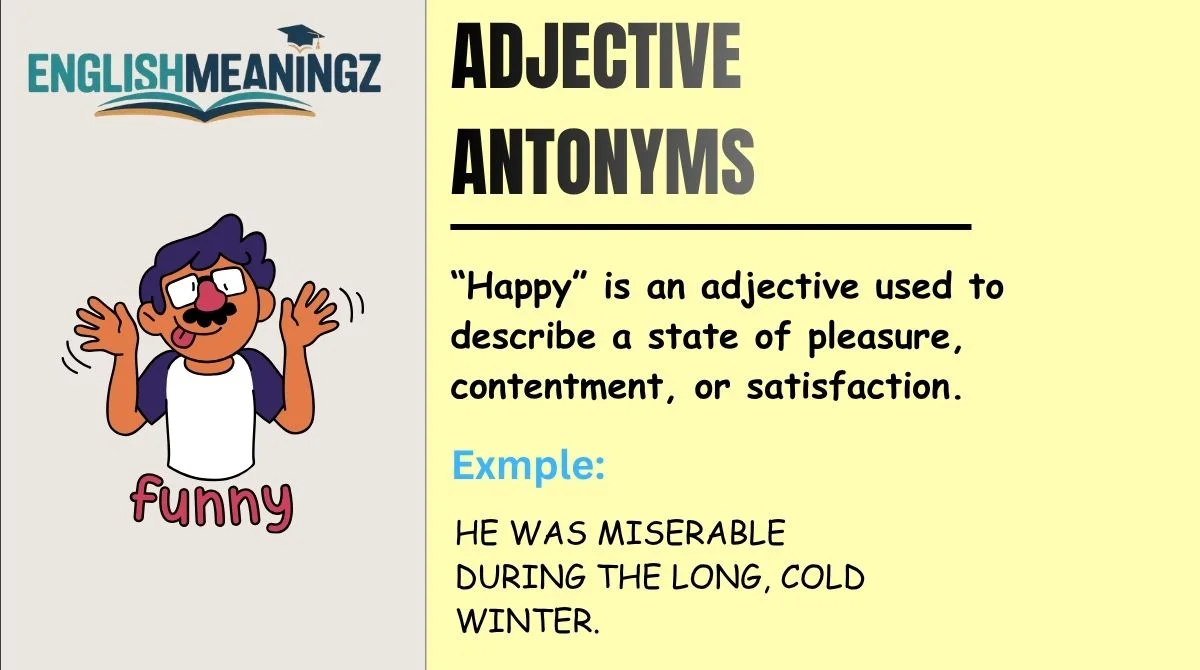
“Happy” is an adjective used to describe a state of pleasure, contentment, or satisfaction.
Tone Explanation:
It carries a positive and emotional tone, often associated with lightness, joy, and well-being.
Emotional Intensity:
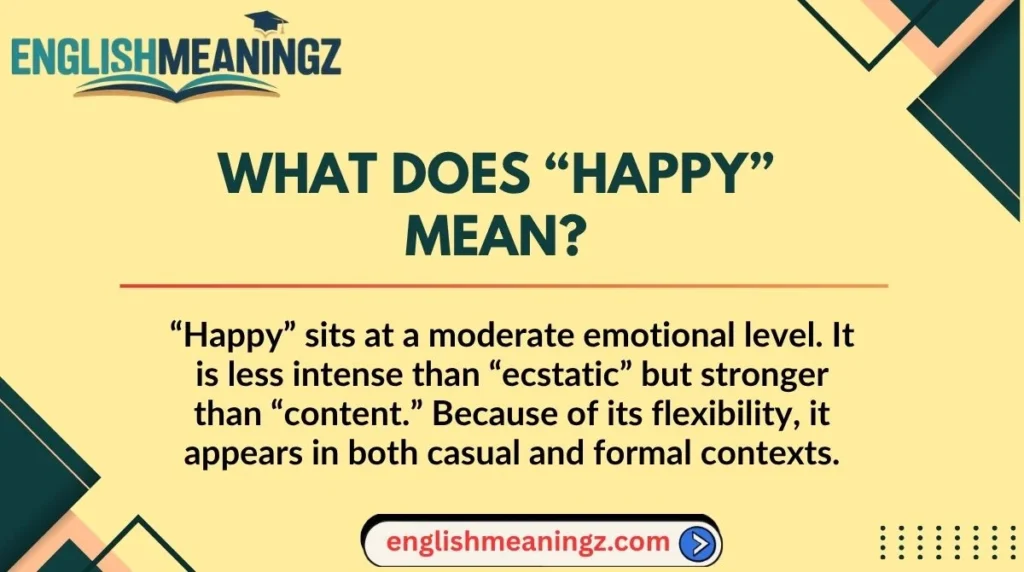
“Happy” sits at a moderate emotional level. It is less intense than “ecstatic” but stronger than “content.” Because of its flexibility, it appears in both casual and formal contexts.
16 Best Antonyms for “Happy”
1. Sad
Meaning: Feeling sorrow or unhappiness
Tone: Emotional
Example: She felt sad after hearing the news.
Why Opposite: It directly contrasts the emotional positivity of happiness.
2. Miserable
Meaning: Extremely unhappy or uncomfortable
Tone: Emotional
Example: He was miserable during the long, cold winter.
Why Opposite: Represents a stronger negative state than sadness.
3. Depressed
Meaning: Deep, persistent sadness
Tone: Clinical / Emotional
Example: She appeared depressed after the failure.
Why Opposite: Indicates prolonged unhappiness, unlike temporary joy.
4. Unhappy
Meaning: Not happy; dissatisfied
Tone: Neutral
Example: The customer was unhappy with the service.
Why Opposite: A direct and simple negation of happiness.
5. Gloomy
Meaning: Dark, pessimistic mood
Tone: Descriptive
Example: His gloomy attitude affected the team.
Why Opposite: Replaces brightness with emotional darkness.
6. Melancholy
Meaning: Deep, reflective sadness
Tone: Formal / Literary
Example: The music had a melancholy tone.
Why Opposite: Contrasts joy with thoughtful sorrow.
7. Heartbroken
Meaning: Overwhelmed with grief
Tone: Emotional
Example: She was heartbroken after the loss.
Why Opposite: Represents emotional devastation versus happiness.
8. Discontent
Meaning: Dissatisfied or restless
Tone: Formal
Example: Workers felt discontent with the policy.
Why Opposite: Opposes the satisfaction inherent in happiness.
9. Angry
Meaning: Feeling strong annoyance or rage
Tone: Emotional
Example: He grew angry over the unfair decision.
Why Opposite: Shifts from positive emotion to aggressive negativity.
10. Bitter
Meaning: Resentful and harsh
Tone: Emotional
Example: She became bitter after repeated failures.
Why Opposite: Replaces joy with resentment.
11. Hopeless
Meaning: Without hope or optimism
Tone: Emotional
Example: The situation felt hopeless.
Why Opposite: Removes the positivity linked to happiness.
12. Dejected
Meaning: Low in spirits
Tone: Formal
Example: He looked dejected after losing the game.
Why Opposite: Reflects emotional defeat rather than joy.
13. Despairing
Meaning: Experiencing complete loss of hope
Tone: Emotional / Formal
Example: She gave a despairing sigh.
Why Opposite: Extreme contrast to happiness.
14. Sorrowful
Meaning: Full of sadness
Tone: Formal
Example: His sorrowful expression said everything.
Why Opposite: Emphasizes emotional pain over pleasure.
15. Downcast
Meaning: Feeling low or discouraged
Tone: Descriptive
Example: She appeared downcast after the interview.
Why Opposite: Reflects reduced emotional energy.
16. Troubled
Meaning: Distressed or worried
Tone: Neutral
Example: He seemed troubled by the situation.
Why Opposite: Indicates mental unrest rather than contentment.
Strong vs Mild Opposites
Not all antonyms carry the same intensity. Understanding this difference helps you choose the most accurate word.
Mild Opposites:
- Unhappy
- Discontent
- Downcast
These suggest slight dissatisfaction rather than deep emotional pain.
Moderate Opposites:
- Sad
- Gloomy
- Troubled
These convey noticeable emotional discomfort but not extreme distress.
Strong Opposites:
- Miserable
- Depressed
- Heartbroken
- Despairing
These express intense emotional suffering and should be used carefully, especially in formal or academic writing.
Choosing the right level of intensity ensures your message is precise and appropriate for the context.
Context-Based Opposites
Antonyms are not always fixed—they depend on context.
- In casual conversation, “sad” may be enough.
- In literature, “melancholy” adds depth and tone.
- In psychology, “depressed” carries a clinical meaning.
Example:
- “He was unhappy with the results.” (General dissatisfaction)
- “He was devastated by the results.” (Emotional intensity)
The situation determines which opposite fits best.
Common Mistakes When Using Opposites
1. Using overly strong antonyms
Incorrect: She was depressed about missing the bus.
Correct: She was annoyed about missing the bus.
2. Ignoring tone
Incorrect: The report had a sad conclusion.
Better: The report had a concerning conclusion.
3. Confusing emotional vs logical opposites
“Happiness” relates to feelings, so its antonyms should also be emotional.
4. Overusing basic antonyms
Repeating “sad” reduces variety. Use alternatives like “gloomy” or “dejected.”
Sentence Transformation Examples
1. Original: She felt happy about her success.
Rewritten: She felt disappointed about her success.
2. Original: He was happy with the results.
Rewritten: He was dissatisfied with the results.
3. Original: They looked happy at the event.
Rewritten: They looked gloomy at the event.
4. Original: The child was happy to see her parents.
Rewritten: The child was upset to see her parents.
5. Original: She remained happy despite challenges.
Rewritten: She remained troubled despite challenges.
FAQs
What is an antonym?
An antonym is a word that has the opposite meaning of another word.
Are all antonyms exact opposites?
No. Some are partial or context-based opposites rather than perfect contrasts.
Why are antonyms important in writing?
They improve clarity, precision, and expression by offering contrast.
Can one word have multiple antonyms?
Yes. Depending on context, a word can have several valid opposites.
What is the difference between strong and mild antonyms?
Strong antonyms show extreme contrast, while mild ones show slight difference.
How can I learn antonyms faster?
Practice using them in sentences and group them by intensity.
Are antonyms used in formal writing?
Yes, especially in academic and analytical contexts where contrast is important.
Conclusion
Mastering antonyms is more than just memorizing word pairs—it’s about understanding nuance, tone, and context. By learning how to choose the right opposite, you gain the ability to express ideas more clearly and powerfully.
The 16 antonyms explored in this guide show that even a simple word like “happy” has a wide range of opposites, each with its own intensity and usage. When used correctly, these words can elevate your writing, making it more engaging, precise, and professional.